
How do you use this material?
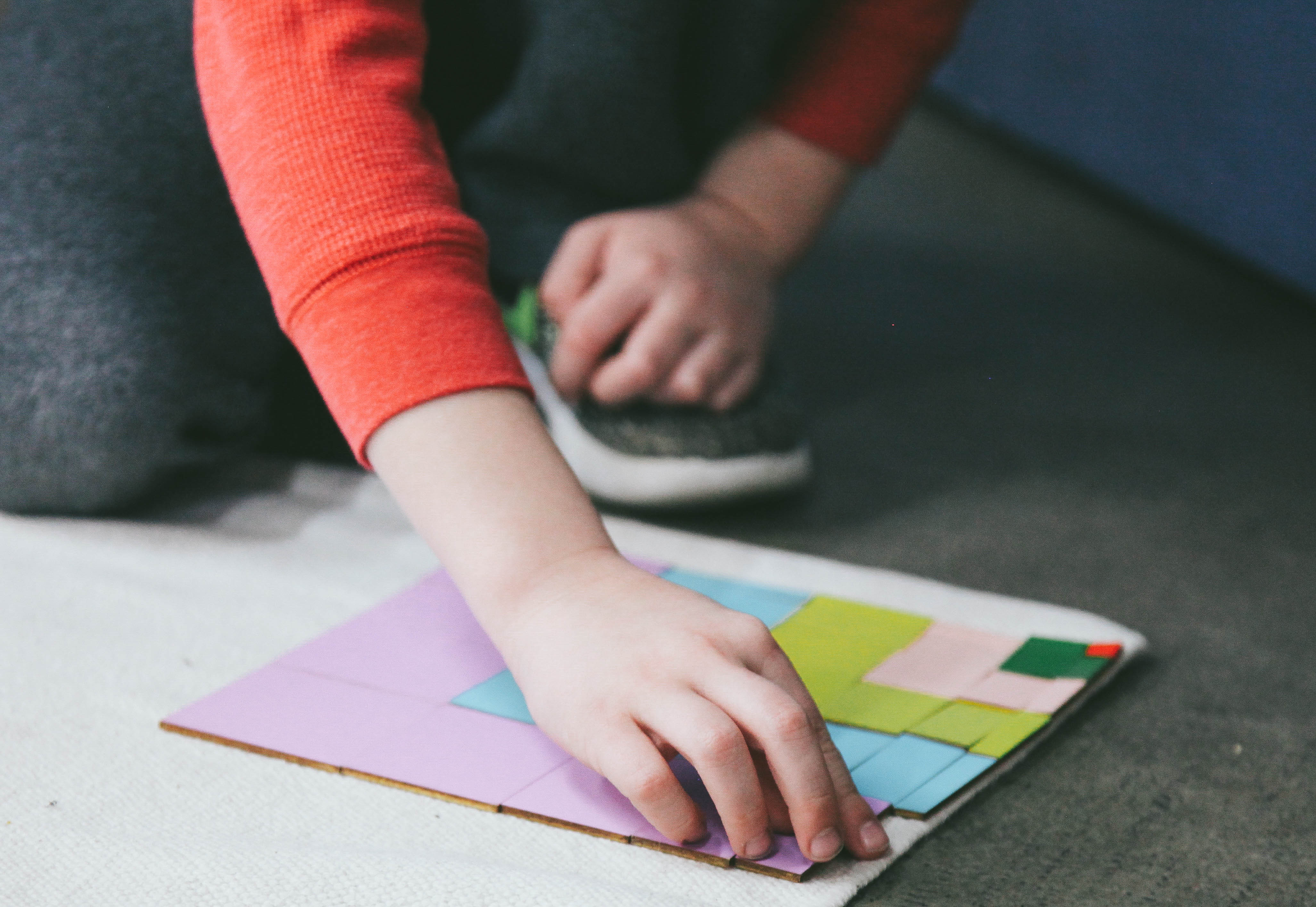
This is one of the most beautiful materials in the classroom, and it requires a high level of patience, attention to detail, and logic. First a child gets out a large rug. A child brings the box containing the Decanomial Square to the rug. There are 10 squares, ranging from 12 to 102, as well as pairs of rectangles with the proportions of the square and all the squares that came before. For instance, the square 4×4 also has three pairs of rectangles, measuring 4×3, 4×2, & 4×1. The colors of the squares and rectangles correspond to the colors in the bead cabinet.
The child removes only the squares, stacking to create a pyramid. Starting with the smallest square, a red square measuring 1×1, the child begins to build the Decanomial Square.
[full-image url=”https://baandek.org/wp-content/uploads/2019/03/1-1.jpg” alt=”baan dek decanomial square montessori” width=”5616″ height=”3744″]The child places the first square at the top left corner of the rug. The next square, a green square measuring 2×2, is placed diagonally adjacent to the first, and two rectangles measuring 2×1 are placed with the side measuring 2cm against the green square, and the side measuring 1cm against the red square. A larger square has been formed.
The child places the third square, a pink square measuring 3×3, diagonally adjacent to the green square. The two pairs of rectangles measure 3×2 & 3×1. The wider pair is placed on either side of the pink square, with the 3cm side touching the pink square, and the 2cm side touching the sides of the green square. The narrower pair is placed next, with the 3cm side matching with the first pair of rectangles, and the 1cm side touching the green rectangles measuring 2×1. A new, larger square has been formed.
This pattern continues as increasingly larger squares are formed.
After this first activity has been mastered, a child will explore with this material, building squares using just the rectangles, and using the smaller squares to create larger squares (for instance, building the 8×8 square using the 2×2 square, the 6×6 square, and the pair of 6×2 rectangles.
[full-image url=”https://baandek.org/wp-content/uploads/2019/03/2.jpg” alt=”baan dek decanomial square montessori” width=”5453″ height=”3682″]What is the child learning?
A child is learning to build squares. This material is very beautiful and precise, and creating order with the tiles, placing them in sequence to build increasingly larger rectangles, is immensely satisfying.
What does a child not know they’re learning?
In addition to the logical patterning the child is developing, the child is preparing for mathematics, specifically for geometry, algebra, and squaring.

Baan Dek
An incredible Montessori foundation for children and an inspirational resource for teachers and parents.