

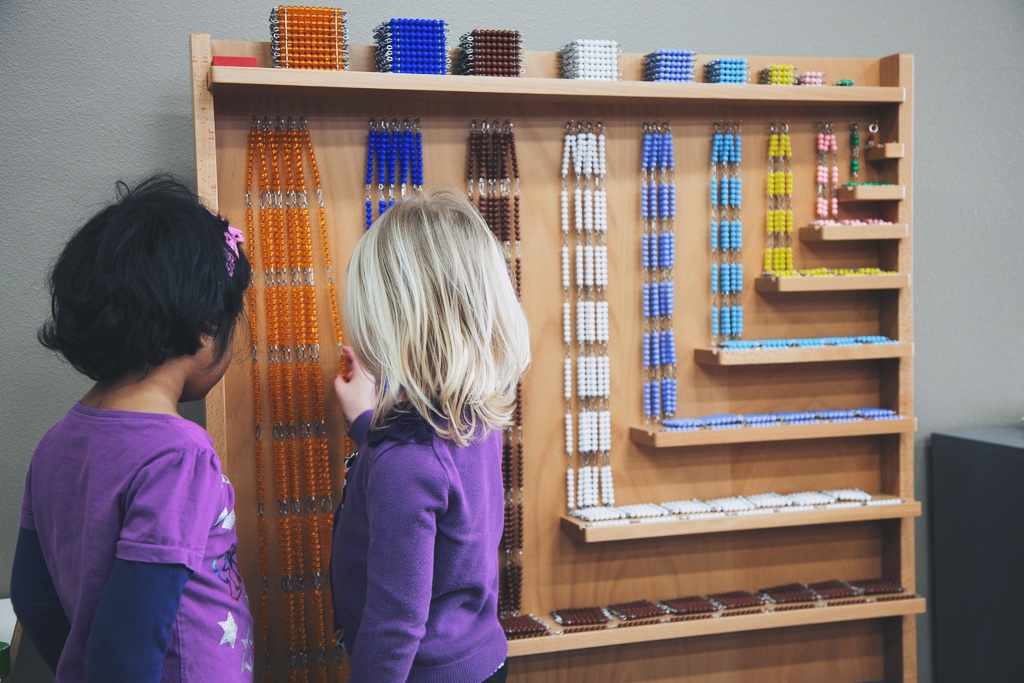
The Bead Cabinet is the stuff of magic.
When a student first walks into the Montessori classroom, takes a deep breath and surveys the room, they are instantly drawn towards the beauty, simplicity and elegance of this seemingly magical material called the bead cabinet.
Yet, what is it?
Visually, it’s probably the most stunning activity in the arsenal of activities, with it’s appropriately sized, yet somehow drastically appealing presence. It’s a big, complex work, something that the children inevitably aspire towards.
But, what is its function?
[full-image url=”https://baandek.org/wp-content/uploads/2015/02/amazement.jpg”]The younger students, who are not yet ready for the activity, often watch on in amazement (and admiration) as their older peers diligently engage with this delicate, intricate, almost other-worldly series of exercises. They literally think it holds the keys to the universe.
What are these secrets?
For adults no less, there’s something that mysteriously entrances us, that summons us towards the mathematical precision and sophistication of the bead cabinet. Colorful, yet somehow masterfully subdued, we are seduced by it’s ability to not-so-secretly captivate our attention.
What is it that interests us so?

While we immediately recognize the concrete value of the activity, harking back to how we learned square and cubed roots, we somehow have the ability to envision something else entirely: how these abstract concepts that we struggled with will shimmer in our child’s imagination. As Montessori says:
[quote] We must first present the whole idea through materials and help the child move freely towards abstractions. [/quote]Not only is there a carefully thought out organizational system to the appearance of the cabinet, both by size and color, there is also break-out thoughtfulness to the individual activities themselves, which we will highlight in what follows.
Let’s take a visual walk.
[full-image url=”https://baandek.org/wp-content/uploads/2015/02/montessoribeadcabinet2.jpg”]What is the material?
• Short and Long chains for each number 1 through 9.
• Sets of labels that correspond in color to the chains.
• Squares that correspond to those presented by the chains.
• One cube for each set of short and long chains.

Purpose:
There are multiple purposes to the activity. Or, as Montessori relays, both direct and indirect aims. One of the primary ambitions of the exercise is to offer children further experience as they learn how to count.

Transitioning to the abstract, with just numbers – as opposed to something tangible, like beads – requires a certain amount of practice. The bead cabinet work offers just that. The teacher may associate the quantity with squares, “Now we know here is twenty-five in the square of five”.

Children are continually reassured by their progress. Working independently, they confirm that what they see numerically written, matches up with how many beads they can physically count.
[quote] This is the passage to abstraction. After a while the child will leave the material and solve problems directly on paper. [/quote]Through their commitment to this rather lengthy work, which requires as much physical space as it does mental patience, concentration and determination, children come to appreciate the concept of multiplication. Not incidentally, they also come to understand what it means to square and cube numbers.
As an important aside, you’ll also notice from the photo above, the opportunity to utilize those fine motor skills, with the manual dexterity that is ever so heedfully applied. The work itself solicits a certain level of persistence, as it calls children towards its mysteries.
You can literally see the joy of the discovery in their eyes, as the children make the association from the concrete to the abstract.
From that which they once held easily in their hands, to what they now slowly form in their imaginations, math takes on a powerful, magical, scientific sense. While the Montessori bead chain often carries our students into the hallway, which is a large enough space to accommodate the activity, we wonder where else it will lead them.

Baan Dek
An incredible Montessori foundation for children and an inspirational resource for teachers and parents.