
Yes, we believe that mistakes are important, that they must not be underestimated, and that they are a vital and timely component to our ability to learn.
It might seem counterintuitive, but mistakes are addressed positively and with affirmation in Montessori. Children are actually given the confidence they need in order to make mistakes.
Indeed, making mistakes is important. Also, and this is the topic of this post, it is important how we, as adults, as teachers, as friends, learn how to respond to mistakes.
In Montessori classrooms, we try to create the conditions in which each and every child succeeds. With success, of course, comes trial and error. Knowing what works, and how it functions best.
It’s not that we encourage mistakes, but rather that we support them. We find value in there misgivings and misapprehensions. They give us courage to try harder next time, with resolve and determination.
In traditional schools, your mistakes are discovered for you. In Montessori, we discover our own mistakes. It might seem like a turn of phrase, but it’s a revolution in the way we approach education.
We all remember how mistakes are handled in traditional education. You probably even have vivid recollections of a pop quiz that you failed, or a teacher that gave you a positive or negative mark.
You see, it’s the same logic. Conventionally, it doesn’t matter if you get the answer right or wrong. It’s the way the system is established. It affects our willingness to engage in difficult problems.
Homework and tests, they don’t fully account for the importance of mistakes. They’re designed, not to support and encourage us. Instead, they are set up for us to fail, to try to deceive our knowledge.
With that in mind, this is not a post about assessment, or evaluations, but rather, the importance of mistakes, and the ability to productively incorporate what it means to error.

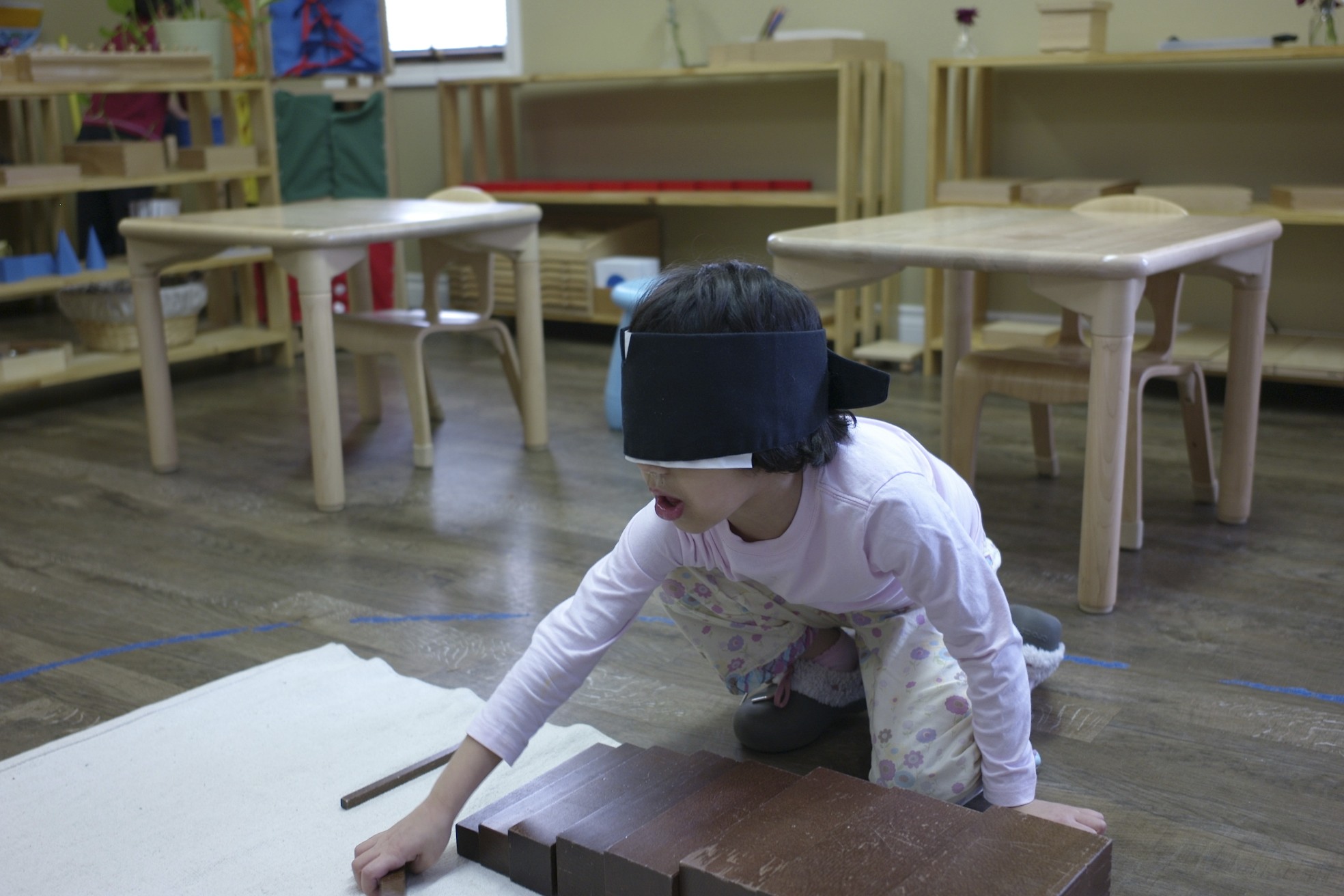
Take, for example, the boy pictured above. He’s engaged in the brown stairs activity. The way the activity is devised, is that the student will recognize if something is out of place as it’s constructed.
There’s no teacher hovering over his work. There are no students with which he will engage in a competition of perfection. It’s just him and his confidence, growing and growing, as he stacks the stairs.
You see, it’s an entirely different logic. Montessori doesn’t focus on memorization, or recollection. It’s predicated on the ability to gain confidence, and the independence needed to think for oneself.
That’s where we come in, as parents, as educators, as members of the community, to offer the support and guidance children need in order to discover their own mistakes.
Of course, the paradox is: Montessori students are less inclined to make mistakes, because they’re not afraid of them. They understand the power of creating a system that recognizes the importance of mistakes.
We have a phrase that we like to share around here: An encyclopedia of mistakes may be even more helpful than a dictionary of good ideas.

Baan Dek
An incredible Montessori foundation for children and an inspirational resource for teachers and parents.