
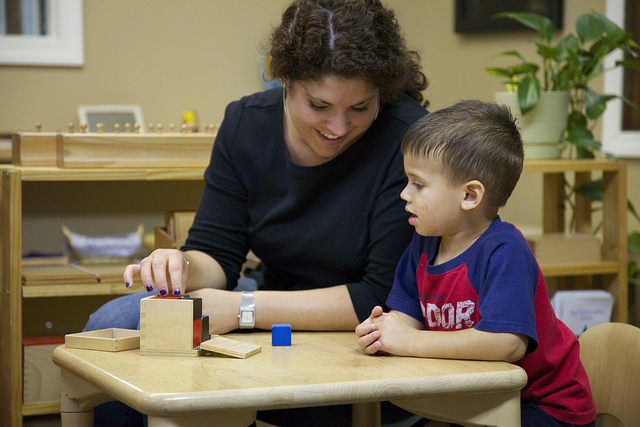
What is the Montessori guide? We thought it would be helpful to highlight some of the unique traits of a Montessori “teacher”. Why do we call them guides, as opposed to teachers, for instance? In Montessori, we are not teachers, at least not in a conventional sense. Instead, we are the people who put the children in touch with their envionment, following their interests. That’s why we call them guides. On this model, then, it is not the adults who are the teachers, but the children. In essence, they learn to teach themselves.
Maria Montessori famously said that when she was looking for a guide, ideally, she’d like to find someone that wasn’t a teacher. As a matter of fact, she was looking for someone with no preconceived notions of what it means to “teach”, mainly because, Montessori is so very different from traditional approaches to education. Here’s why: In Montessori, it is the children who are the center of attention, and not the teacher. The role of the guide in Montessori is the preparation of the environment, and finding ways in which to connect children to the materials. The focus is on the children, not on the teacher. In short, our role becomes one of observing the individual interests of each and every child, recognizing that everyone learns differently, and at their own pace. Montessori believed that, ‘there cannot be only one way to learn, any more than there can be only one way to teach.’
As a result, you’ll note the composition of the Montessori classroom. Children are typically dispersed throughout the environment, working individually, or in small groups. There is no heirarchy, as there is in a traditional classroom. The children are free to explore their own interests. They are not bound to sit in assigned seats. Also, and as a fundamental point of difference, Montessori guides are taught to keep their presentations as short as possible. The longer we stay with the children, the more dependence we foster. Our role, as guides, is to intrigue the children and inspire them to pursue these activities on their own. We want nothing more than for them to be able to use the materials without us.
Where is the shift in focus? One of the crucial aspects, as opposed to traditonal teachers, is that Montessori guides focus on each and every child, independently, and not on one generic lesson plan intended for everyone. Our ambition is not to prepare children for tests, but to prepare children for life. We want to inspire a love of learning, and an ability to create questions and think on your own. Guides don’t merely offer presentations, they facilitate engagement, curiousity and interest, fostering creativity and independence.

Baan Dek
An incredible Montessori foundation for children and an inspirational resource for teachers and parents.