The Importance of Kindergarten

One of our parents, Donoso S. Escobar, was kind enough to share his thoughts on the "Importance of the Kindergarten" year in Montessori. We would love to now share them with you.

For my five-year-old child, kindergarten at Baan Dek Montessori School has been a journey underpinned by cognitive and academic skills development as well as mental health and emotional development.

The pre-kinder days of my child were days of occasional moments of anxiety when both, my wife and I wished we would not have studied human development theory so intensively during our graduate work. As parents, Julia and I consider the practice of home schooling as socially irresponsible; however, the over protective father within me, questioned: how were we going to entrust our introverted child to a world unknown to her? Of course, the answer came with no hesitation from my wife who said, “precisely, because she needs to be introduced firmly and gently to the beginning of formal education now.”

As the academic year approaches its conclusion, the transformation of our child is evident in three specific areas. Social skills, she has become an assertive and compassionated person who leads by example and is excited about new challenges. Cognitive development, for example, her inquisitiveness about the trail of tears stunned me recently. After our conversation on the trail of tears, she commented: “Papa, the truth is that there are bad White people and good White people; there are good Indians and bad Indians; there are good Black people and bad Black people.” Finally, emotional development is best illustrated by a short family story. Our second child is four years old now and has become her older sister’s best friend; a nice friendship that evolved from “Papa, let’s take little Sister to the Rainforest and leave her with the howler monkeys there.” This was three years ago. Most recently, I overheard Older Sister saying to little Sister, while playing house: “I will protect you always, because I love you so much; I will wipe your tears with a kiss when you cry, you are my sister and I love you.” To which little Sister responded: “May I call you Mama?” We attribute these dramatic changes to the influence of Baan Dek Montessori’s Kindergarten education on the life of our child.

In conclusion, a well-organized and professionally administered Kindergarten program sets the developmental course of a human being in a manner that no parent could match. Largely, this is because of the complementary nature of some roles during human interaction. Family propels children to embrace learning; the Kindergarten event shapes children to be life-long learners.

Baan Dek Summer Camps

Leap into Summer, with Baan Dek Summer Camps!

Put away your backpacks, and get out your sunglasses. This is going to be the most exhilarating Summer Camp that we've ever put on. We're going to knock it out of the park.

Each week will be an entirely different educational experience, devoted to an entirely new topic. One week will be dedicated to learning about cooking, while the next week will be spent exploring art or architecture.

Each week will also either have a special guest visitor or an exciting field trip planned. We think you're in for a treat, and we can't wait to get started. Summer, here we come!

Space is limited, so sign up now! www.baandek.org/summer

The Concept of Zero

There's a really wonderful origin story about the concept of zero. In Architecture as Metaphor, Kojin Karatani, writes: "Zero was invented in India and was originally the name for not moving a bead on an abacus. If it were not for zero, the numbers 205 and 25 would be indistinguishable." That's a pretty powerful thought. We thought we would take this opportunity to further elucidate how the concept of zero is imparted in Montessori.

First, it's important to remember that the way children learn math in Montessori, is through the concrete. Which is to say, we introduce children to the quantity, and then the symbol. For example, when we teach the concept of numbers, children first explore the red rods.

After the red rods have been mastered, we then introduce the number rods, which, as you can see, are differentiated. Again, focusing on the concrete, we later introduce a number to represent each rod. So, for instance, we would place the number 10, next to the number rod that has ten units. We only reach this activity, once we're certain that the student knows the quantity.

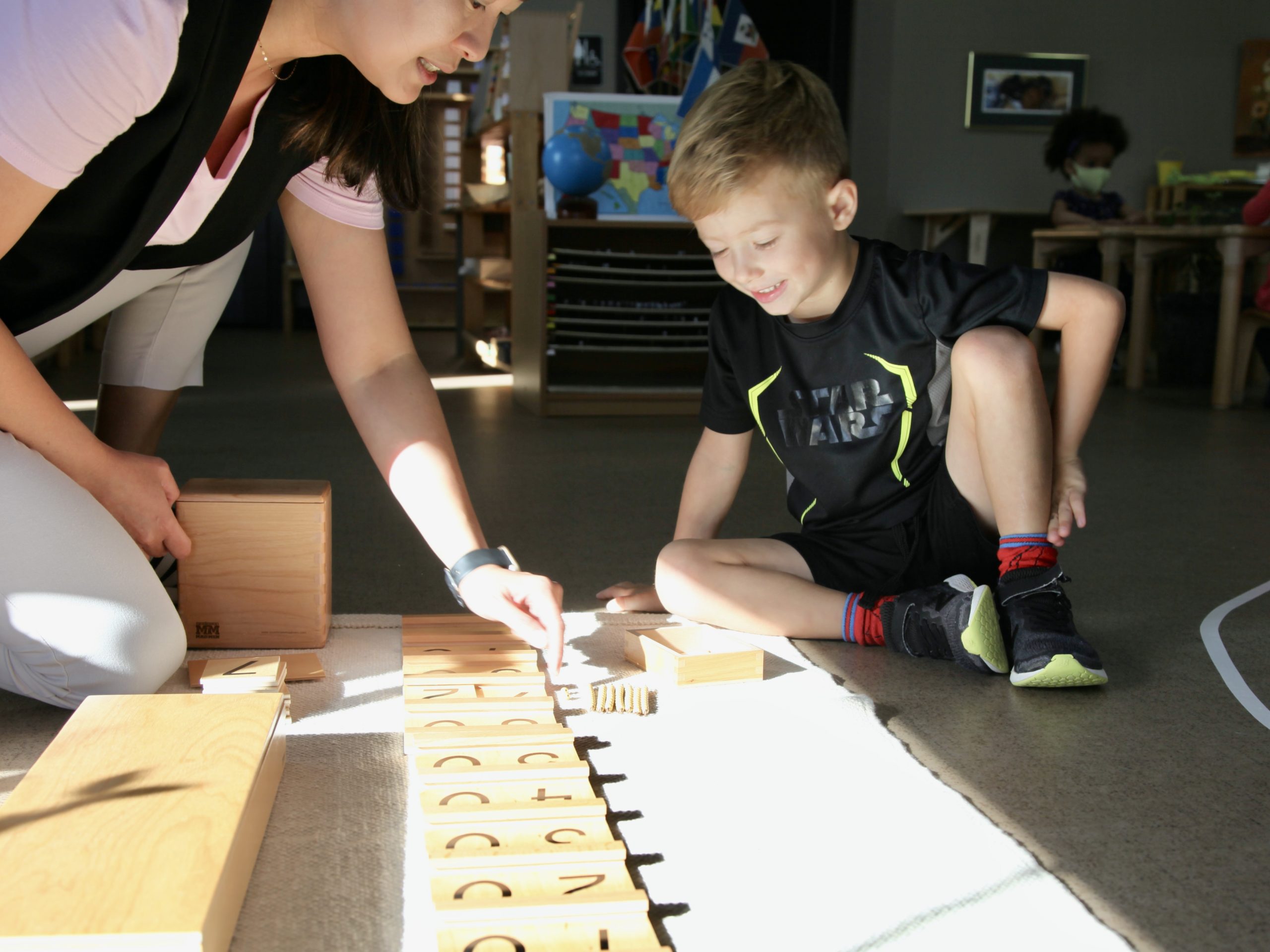
So, how do we confirm that children understand the concept of zero? With the spindle boxes, as pictured above. Slowly moving away from the concrete, towards the abstract, there is a box with 10 slots to add spindles. The object of the activity is to place the correct amount of spindles in the appropriately marked box. The first slot, marked 0, will contain no spindles, while the last box, marked 9, will contain 9 spindles. Hence, the child comes to understand that zero demaractes no quantity. While the concept of zero may seem rather obvious to us as adults, it can be an extremely difficult concept to teach children.

Spotlight Anna Lee

We're extremely pleased to Spotlight Anna Lee, from Meadows Montessori, in Fredrick, Maryland. We first encountered Anna through her lovely talk on TEDx, which we've posted below. From the very start, we felt her contagious energy and passion for pushing things at least one step further. Now that we've learned more about her and her school, we think you're in for a treat. Enjoy! 

Q: Can you tell us a little bit about yourself? Your background, your interests, your dreams?

A: I'm a child of public school from one of the best academically scored counties in the country. However, I don't really have any great memories about my actual education. I memorized, reguritated, and passed the test to pass the grade. I wish I loved school the way that my Montessori students love to work. My Korean parents encouraged me to take violin, cello, and piano classes while attending weekend Korean school and Kumon throughout my childhood. My parents clearly wanted the best for me, and I am so incredibly thankful that they tried. What they didn't realize was that what I was really learning from them. I grew up watching them both work hard to make sure my brother and I lived in this specific county to go to these schools. Shuffling to and from classes, struggling to speak proper English, and making sure to make homemade Korean food every night for dinner. I don't thank my work ethic because I'm a Capricorn, but because I am a child of my environment.

I love my work as a director of education. I am able to teach children, train my staff, educate my families, and stay abreast of all the current issues of education in our country. I can sleep well at night knowing that I've dedicated my life to helping children foster their full potential. Essentially, helping to change our future for the better. "If help and salvation are to come, they can only come from the children, for the children are the makers of men"- Maria Montessori.

Q: Do you have a favorite book? How about a film?

Hands down, my all time favorite book is The Little Prince by Antoine de Saint Exupery. I may have bought and given away close to a hundred copies of it. I encourage any adult to have it bedside. The film Baraka inspires my outlook on life and travels, I highly recommend it!

Q: Can you tell us about your hobbies?

A: You can find me globe-trotting to an unusual part of the world or wandering around an art museum. My favorite thing to do is laugh and eat sushi (all at the same time).

Q: Switching to Montessori, what advice do you have for new Montessori schools?

A: One word: RESEARCH. In our product driven society, our government wants "evidence of learning." Investing in quality research gains more traction than any type of publicity.To our larger community, we need to place all of our energy and money into research. Montessori teachers and parents have seen it with our own eyes, yet it was because of a leap of faith that parents mostly joined in the beginning. As our evidence of learning spilled out organically without assessments, parents re-enrolled with trust and faith.

Also, new or old, first thing is first: practice what we preach! Montessori's philosophy should never just stop at the classroom door, it should extend outside of those walls and into the staff and administration, and yes, even the owners and board. Montessori teachers all start out passionate and full of rigor. To sustain and replenish this year after year (or decade after decade), it's essential to support the hearts of these teachers. To take the oath to be a Montessorian, it is almost like taking on a lifelong responsibility to constantly defend what and why we do what we do. It never gets easier, or harder... it is just continuous. Montessori has been around for over a hundred years, and yet it is often labeled as being innovative and progressive education to the general public.

One of our biggest pitfalls as a community is that we sometimes become so concerned about where we received our training, who we worked for, how many years we have seniority over the other, or even worse- what organization we're affiliated with. This goes back to practicing what we preach, we need to put emphasis on supporting our Montessori neighbors, and helping them to strive for higher standards. This alone will begin to diminish the misunderstandings that the general public come across as they visit or experience schools that are more hybrid traditional and Montessori programs. It's a harsh reality that most of our schools are businesses, and what tends to steer the ship is enrollment, enrollment, enrollment. How do we make sure that that passionate Montessori teacher has a job at the end of the year? What makes your school stand out from the other three schools in a 5 mile radius? How do we keep the integrity of the Montessori philosophy and methodology in tact as parents begin to challenge your teachers or opt for public school? We all know how we have answered these questions within our own schools.

Q: How have things changed since you first got started in the field of education?

A: A generational shift has been happening. Our mentors and fore(mothers) in our Montessori community who started teaching back in the 60s and 70s are beginning to gracefully retire and leave our field. It's now the responsibility of my generation to keep that flame alive more than ever. With our education system now under a microscope and an emphasis on early childhood education, we can not hide or be ignored anymore.

Q: What do you think is the best introduction to Montessori?

A: The BEST introduction is to go and observe an authentic Montessori classroom. It will astound and educate anyone.

Q: What continues to inspire you about Montessori?

A: One of my favorite passions in life is to travel and visit other Montessori schools around the world. It's a chance for me to remember that our community extends beyond my city, state and country. I may be in a completely culturally different country, but as soon as I step foot into a Montessori school it feels like home. We all face the same issues of enrollment, educating the public about Montessori, and the pressures of explaining the curriculum to families. Our mission is not a lonely one, and it's inspiring to know that our cause is an international one.

Q: How do you feel Meadows Montessori can impact the community at large?

A: We pride ourselves as an authentic Montessori program, and we can actually explain why. We lend ourselves to anyone in our community who would like to know more about what we do. We're HUGE into parent education and parent involvement. It's the most effective way to spread the advocacy seeds into the public.

Q: In what ways do you envision the future of education?

A: A couple of years ago I stepped into a public middle school in a very affluent community just outside of Washington D.C. When I walked in, I didn't find where most would find class pictures and athletic awards behind glass. Instead, there were charts showing how each grade level and race were scoring in Math and Language in this school. Horrified?... absolutely. However, as I walked down to their lower level classroom I found some classrooms tucked away in the corner. The rooms had a different subject areas separated into different parts of the room, a large sink to wash dishes and utensils after lunch, a quiet reading corner, and even a mixed age group of students. Was this a Montessori classroom? Nope! It was the school's special education program. The students here were diagnosed with Autism, Downs, and developmental delays. Once the occupational therapist got wind that I was a Montessori teacher, she quickly grabbed her Mary Poppins' bag of materials and pulled out some old, heavily used metal insets! She said that she's been using them for over a decade to help her students with handwriting. This wasn't an authentic Montessori classroom, but I can honestly say that these special needs students were much more well off than their peers upstairs.

I can not guess what will happen next with the growth of more Montessori schools and charter schools. Our country has already begun to validate and standardize all Montessori schools state by state. Change takes time, and our ideals will be tested when we were to begin the overlap of pedagogies if our community's true goal is to provide Montessori education for all, for free.


We want to thank Anna for this inspirational exchange. We also want to point you in the direction of her highly informative and refreshingly brilliant TEDx talk.

1 Unit, 1 Ten, 1 Hundred, 1 Thousand

You've probably heard us say this before, but if there's one way to describe Montessori, it is that the only way to achieve the abstract, is through the concrete. Now, there's a lot at work in this photo, which we thought we would take the opportunity to elucidate in greater detail.

First, you'll notice the golden beads positioned on the left of the floormat. 1, 10, 100, and 1000. Of course, at this stage, we don't actually represent them with those numerical determinations. We call them, one unit, one ten, one hundred, and one thousand. As soon as the child understands what the concept of one unit is, what it actually, concretely represents, then we introduce them to the abstract representation of that unit, which is the numeral, "1".

Second, you'll also note that this student decided to spell out the golden beads: unit, ten, hundred, thousand. In our estimations, this is a perfect example of how Montessori students come to appreciate math: not that they apply language to mathematics, but they understand that units aren't just represented with numerals.

The famous philosopher Alfred North Whitehead made this exact same point. A different appreciation of math is afforded when you first think about it in terms of the concrete. It's easier to understand how many bricks are in a house when you understand, individually, what those bricks represent.